
Published · Reviewed · M&T Adjusters
This article provides general educational information. It does not interpret any policy, provide legal or safety advice, or guarantee coverage, payment, or results. The applicable policy, endorsements, facts of the loss, and insurer process control each claim. For health, fire, electrical, structural, or contamination hazards, follow public-authority and qualified-professional instructions.
Build a timeline that connects the records
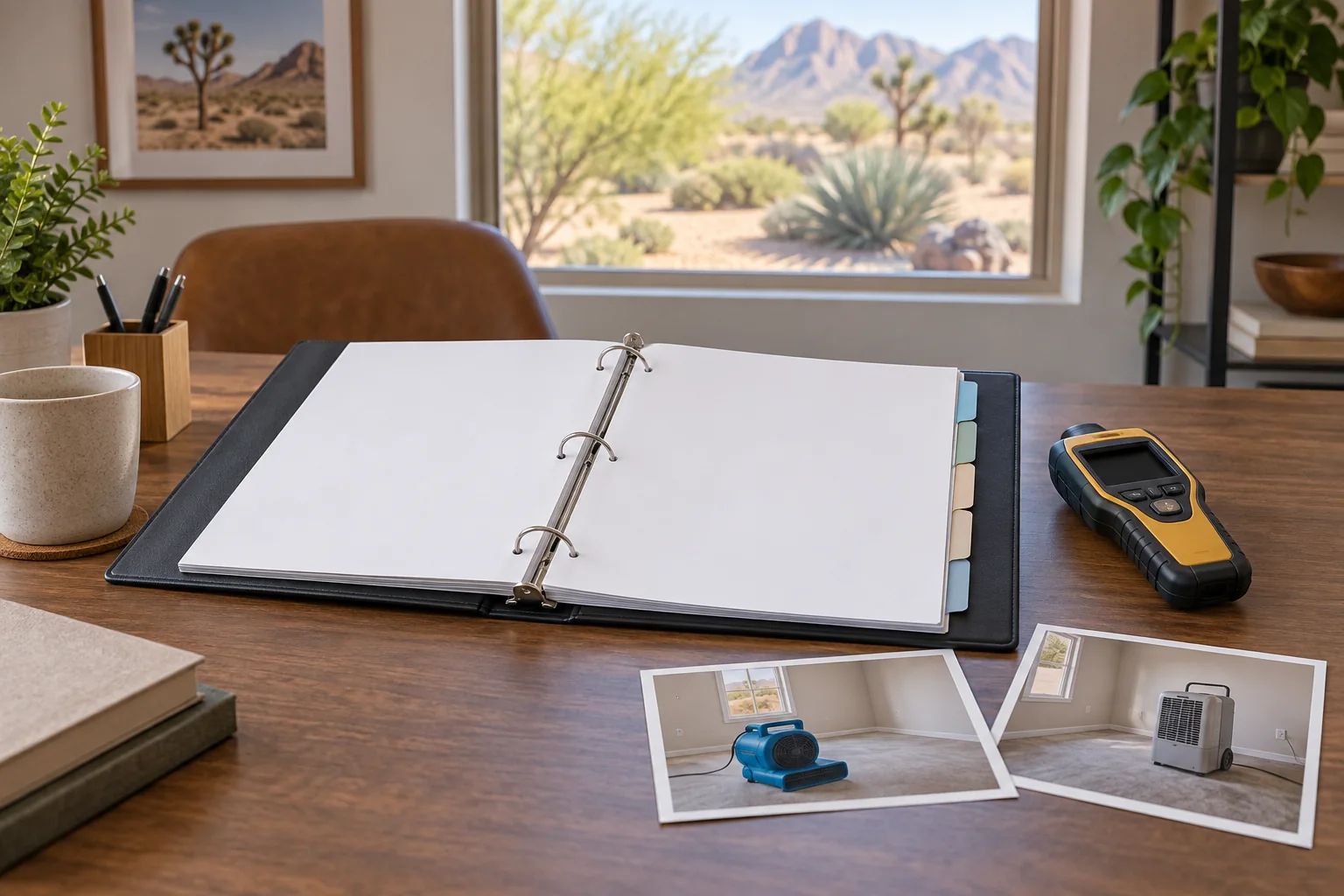
After water damage at a Nevada property, ask the restoration provider for the available moisture reports, equipment placement and removal records, photographs and itemized invoice. Organize them by room and service date. Keep the provider’s findings separate from your observations, and list missing explanations instead of filling them in yourself. These records can explain the work performed; they do not determine coverage, the cause of the loss or reimbursement.
The Nevada State Contractors Board’s Home Improvement Bill of Rights, linked in the sources below, recommends keeping a project file with the contract, changes and payment records. The following optional filing method adds a location-and-date cross-reference for drying work. It is not a required Nevada form or a technical drying standard.
1. Keep the original report and define its locations
Save each report as received, including its date, author and attachments. If the provider uses room abbreviations or numbered measurement points, request the matching sketch or legend. A label such as “north wall” is hard to compare across visits unless the report identifies the room and location consistently. Use the provider’s reference in your own index rather than renaming its measurement points.
Ask what a reported value represents and which material, instrument setting or scale it relates to. Do not assume every number is a moisture percentage or compare unlike readings as though they use the same scale. Preserve the provider’s explanation beside the report. Let the qualified professional interpret whether the readings support the next stage of work.
- Index each entry by service date, room, report page and photograph reference.
- Mark an unclear location or missing attachment as an open question.
- Keep your summary separate from the provider’s original file.
2. Give each equipment movement its own line
For each unit identified in the provider’s records, note its equipment reference, type, room, placement date and removal date. If it moved between rooms, record the move instead of treating it as two machines. Ask for clarification when several similar units appear in photographs but the equipment log uses a different count.
Distinguish delivery, time present at the property, reported operation and the billable period. A photograph establishes only what was visible when it was taken; it does not establish continuous operation. Record a known interruption as an observation with its date and source, then ask the provider how it affected the work and billing. Do not operate, reposition or disconnect equipment to test a charge.
3. Ask for an explanation when dates do not line up
Fictional example: a hallway report records a visit on Monday, the equipment log records removal on Wednesday, and the invoice lists service through Thursday. Keep all three records and ask the provider to explain the different dates and billing units. The difference may have an explanation; the file alone does not establish an error or an overcharge. This is an invented example, not an M&T client result.
If a correction arrives, retain the earlier version, label the replacement and note what changed. If the provider explains the dates without revising the invoice, save that explanation too. Do not shorten the recorded service period or create a missing daily reading yourself. A gap should remain visible until its source resolves it.
4. Separate drying conclusions from repair decisions
Request the provider’s completion report and any remaining limitations or recommendations. Note which rooms and materials it addresses and whether another inspection or specialist is recommended. A pickup slip shows equipment collection; do not turn it into a statement that every concealed area is dry or the property is ready for occupancy.
EPA’s flood-cleanup guidance, linked below, warns that cleanup can be hazardous and discusses help from experienced professionals. It also notes that materials can still need drying after they look dry. Follow the applicable professional and public-authority instructions; this article does not provide cleanup methods, moisture targets or safety clearance. Keep safety decisions with the people qualified to make them.
5. Send a short index with the supporting files
Create a cover note listing the rooms covered, service period, attached reports and unresolved questions. Match each equipment or service line you want reviewed to the relevant log page and invoice line. Keep the work authorization and payment evidence in the same private packet, clearly identified as separate documents. The NAIC’s homeowners-claim guide, linked below, recommends retaining repair receipts and documenting damage.
Ask the insurer which records and secure delivery method it wants. Keep the submitted version and acknowledgment, and forward later corrections with a brief explanation. Do not delay required reporting while waiting for a complete drying report. For the broader water-entry record, use our Nevada monsoon guide; for invoice details, use our temporary-repair invoice guide. Both are linked below.
Frequently asked questions
Clear answers, without promises.
Does the equipment pickup date prove the building is dry?+
No. It records collection. Ask for the provider’s completion findings, the areas they cover and any limitations. Do not treat equipment removal as a safety or occupancy clearance.
Should I copy unclear readings into a new spreadsheet?+
You may make a clearly labeled index, but preserve the original report and identify its page. Ask the provider to explain the units, locations and missing information; do not convert or invent readings.
Does a complete drying packet guarantee reimbursement?+
No. The packet helps explain the work and charges. Coverage, policy conditions and claim facts still require review. Keep the insurer’s questions and decisions with the submitted records.
Official sources
Sources used for this guide.
- Nevada State Contractors Board — Home Improvement Bill of Rights
- EPA — Flood cleanup and indoor air
- NAIC — Filing a homeowners claim
- Related: Nevada monsoon and water-entry documentation
- Related: Nevada temporary-repair invoices
Last editorial review: . External pages may change.