
Published · Reviewed · M&T Adjusters
This article provides general educational information. It does not interpret any policy, provide legal or safety advice, or guarantee coverage, payment, or results. The applicable policy, endorsements, facts of the loss, and insurer process control each claim. For health, fire, electrical, structural, or contamination hazards, follow public-authority and qualified-professional instructions.
Give every detail a location
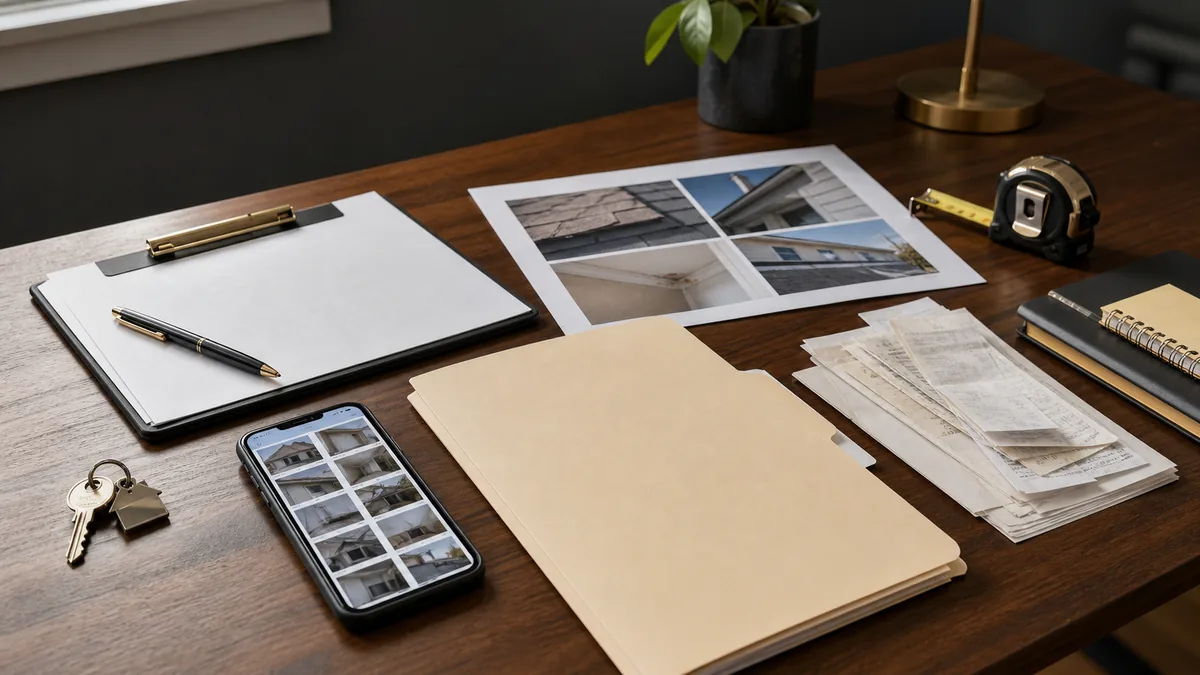
Begin outside with the address area without exposing occupants’ private information, then photograph each elevation and site condition. Indoors, identify the room, take wide views from more than one angle, then medium and close images. This sequence prevents a close-up from becoming an unexplained image.
Use consistent file names with date, room or elevation, subject, and sequence. Keep the original files. If annotations help, place them on copies and never overwrite the unedited image.
- Establish the room or elevation first.
- Photograph adjoining areas and visible boundaries.
- Use adequate light and avoid appearance-changing filters.
- Back up full-resolution originals.
Show scale, material, and path
Pair close damage views with a safe measurement or material identifier. Show flooring transitions, wall layers, cabinet profiles, roofing components, model plates, and waterlines when relevant. A meter display without a room and material reference has limited meaning.
For technical readings, record who took them, the instrument, date, location, and material. Do not interpret specialized readings unless qualified. Ask professionals for a written report that connects each reading and photograph to a location.
- Pair measurements with a wider context image.
- Include visible entry and travel paths.
- Photograph product and equipment identifiers.
- Do not disturb unsafe material for a better picture.
Link contents to a written inventory
Take group photographs before moving items, then assign unique inventory numbers to items needing detail. Record room, description, quantity, brand, model, serial when appropriate, approximate age, and proof of ownership.
If items must be discarded for safety, photograph them first when safe, record the reason and disposal party, and retain vendor or public-health direction. Never keep contaminated items merely for claim evidence.
- Use the same item number in photos and inventory.
- Keep prior photographs, receipts, and manuals.
- Record pack-out, storage, cleaning, and return status.
- Redact private information in public or marketing copies.
Continue documenting through repair
Photograph emergency work, newly exposed conditions, inspections, selective demolition, drying, cleaning, and repair. Use similar camera positions for before, during, and after comparisons.
Maintain a simple photo index and communication log. Nevada DOI advises consumers not to dispose of property before review when possible, so record any necessary exception. Provide requested images through approved channels and preserve proof of delivery.
- Request original vendor photographs and logs.
- Index date, file, room, subject, and photographer.
- Separate the master archive from working copies.
- Keep a second secure backup.
Preserve chronology and privacy when sharing the file
Export a working set in chronological order while keeping the original camera files and metadata in a protected archive. A short index should explain the event, room, viewpoint, subject, and related estimate or vendor record without renaming away the original file identifier. Before transmission, confirm that images do not expose identification, banking details, alarm codes, minors, medication labels, or unrelated personal documents.
Use the insurer or professional’s approved secure channel and retain the upload receipt or delivery acknowledgment. If a file must be compressed or converted, label it as a copy and retain the full-resolution source. This process supports an accurate discussion of observed conditions; photographs alone do not decide cause, coverage, scope, or payment.
- Keep one read-only master archive.
- Share only records relevant to the requested issue.
- Record the date, recipient, and files delivered.
- Never post unredacted claim evidence publicly.
Frequently asked questions
Clear answers, without promises.
Is phone video enough?+
Video is helpful for context, but clear still photographs, measurements, inventories, and organized records usually add needed detail.
Should I edit dark photographs?+
You may make a labeled working copy easier to view, but preserve the untouched original and do not alter the appearance of damage.
Do pictures determine coverage?+
No. Pictures document conditions; the policy, facts, and claim review determine coverage and payment.
Official sources
Sources used for this guide.
- Nevada Division of Insurance — File a Claim
- National Flood Insurance Program — How to Document Flood Damage
- NFIP — Claims Checklist for Policyholders
Last editorial review: . External pages may change.